Business Exit Planning: A Concise Overview

A well‑structured exit plan positions a business for maximum value and a smooth transition. It aligns the owner’s personal goals with the company’s financial and operational readiness, ensuring the business can thrive under new ownership.

Types of Business Exits

  • Full Sale – Sale of 100% of the business to an individual buyer, strategic acquirer, or private equity group.
  • Partial Sale / Recapitalization – Owner sells a portion of the company, often retaining equity for a future second exit.
  • Family Succession – Ownership transitions to children or relatives, requiring training and tax planning.
  • Management Buyout – Key employees purchase the business and continue operations.
  • ESOP – Employees acquire the company through a structured trust, preserving culture and offering tax advantages.
  • Orderly Wind‑Down – Operations close and assets are sold when the business is no longer viable or marketable.

Core Elements of an Effective Exit Plan

Clear Owner Objectives

Define desired sale price, timeline, and post‑sale involvement.

Financial Readiness

Clean, defensible financials and normalized EBITDA increase valuation and buyer confidence.

Operational Transferability

Documented processes, strong management, and reduced owner dependency make the business easier to acquire and scale.

Risk Reduction

Resolve customer concentration, legal issues, and margin volatility before buyers enter diligence.

Diligence Preparation

Organized contracts, tax filings, and operational documentation prevent delays and retrades.

What Buyers Want Most

Predictable Financial Performance

Consistent revenue, strong margins, and transparent reporting.

Operational Independence

Businesses that run smoothly without the owner command higher valuations.

Growth Potential

Buyers seek clear expansion opportunities or strategic synergies.

Clean Legal Structure

Up‑to‑date contracts, IP protection, and compliance reduce acquisition risk.

Bottom Line

Exit planning is about preparation, not timing. Businesses with strong financials, transferable operations, and low risk consistently achieve higher valuations and attract more qualified buyers.


Sincerely,


Gary J. Meyn, LFACHE

210-912-0120

gmeynTX@gmail.com

Will Your Healthcare Business FAIL in 2027?

Due to the scope and depth of suspected and uncovered fraud in our healthcare system. There is a regulatory tsunami facing post-acute and long-term care organizations across our nation. The Centers for Medicare & Medicaid Services (CMS) and commercial insurers are rolling out sweeping administrative overhauls and aggressive compliance enforcement for 2026 and 2027, healthcare facilities operating on outdated Revenue Cycle Management (RCM) practices will face the brunt of these changes.

If your medical billing procedures are not undergoing an immediate, top-to-bottom compliance audit, chances are your facility is hemorrhaging capital through invisible profit leakages and exposing itself to new regulatory noncompliance . Waiting until 2027 to overhaul your RCM processes is just way too risky!


The Regulatory Shift (2026–2027)                         

Across every sector of senior care, home healthcare, skilled nursing, assisted living, hospice, and rehabilitation centers, the rules of reimbursement are being aggressively rewritten. Federal oversight has transitioned into an uncompromising era of hyper-scrutiny designed to strip non-compliant and inefficient providers of their billing credentials.


2026-2027 RCM COMPLIANCE IMPACT MATRIX 

  • Home Healthcare: PDGM Recalibration, Retroactive Revocations, Strict LUPA Thresholds. Nursing Homes: FY27 MDS All-Payer Submissions, Compressed 45-Day.
  • Senior Care: Quality Data Timeframes, PDPM Recalibration.
  • Hospice Care: Service & Spending Variation Index (SSVI) Tracking, Mandatory Election Addendums.
  • Rehab Centers: Outlier Threshold Freezes, Strict Case-Mix, Verification, IRF QRP Audits.


  1. Home Healthcare & Hospice: The Era of Zero Tolerance

Home health agencies are bearing the brunt of the Calendar Year 2027 Home Health Prospective Payment System (HH PPS) updates. CMS is enforcing aggressive behavioral adjustments under the Patient-Driven Groupings Model (PDGM) alongside updated Low Utilization Payment Adjustment (LUPA) thresholds and functional impairment categories. Concurrently, federal anti-fraud initiatives have introduced retroactive Medicare enrollment revocations for compliance violations and expanded enrollment moratoria.

Meanwhile, hospice providers face the newly introduced Service and Spending Variation Index (SSVI). This algorithmic oversight tool tracks non-hospice claims during a terminal election, immediately flagging and auditing providers exhibiting unusual billing patterns.


  1. Skilled Nursing Facilities (SNFs) & Senior Living.

Compression & All-Payer Scrutiny Under the FY 2027 Skilled Nursing Facility Prospective Payment System (SNF PPS) rule, CMS has overhauled the Minimum Data Set (MDS) submission mandates. Facilities must now submit MDS data for all residents receiving skilled care, regardless of payer.

Furthermore, data submission timeframes for quality reporting are being aggressively slashed from 4.5 months down to 45 days. Missing these hyper-compressed windows results in immediate, irreversible reimbursement penalties and severe Value-Based Purchasing (VBP) rate reductions.


  1. Rehabilitation Centers & Assisted Living:

Reimbursement Caps & Audit Traps Inpatient Rehabilitation Facilities (IRFs) and long-term care hospitals face frozen outlier thresholds ($78,936) and strict productivity adjustments. With inflation driving operational costs skyward, improper clinical documentation or misaligned diagnosis coding instantly flips margin-positive patients into severe net-loss liabilities.


Qualification & Governance Tightening Across All Payers. It is not just traditional Medicare that is tightening the vise. Payers across the entire healthcare ecosystem have aligned to enforce ruthless billing restrictions:

  • Medicare & Medicaid: Federal integrity measures now mandate total transparency in ownership structure—including explicit disclosures of Private Equity (PE) and Real Estate Investment Trust (REIT) backing on Form CMS-855 filings. Billing staff must satisfy stringent credentialing and risk-based survey validations to maintain active reimbursement billing rights.
  • Commercial Insurance & Managed Care (MA/MCO): Commercial payers are deploying AI-driven claims processing algorithms designed to automatically reject claims with minor documentation gaps, billing code discrepancies, or missing prior authorizations.
  • Private Pay & Private Insurance: Assisted living and senior housing providers taking private pay must navigate complex state-level transparency mandates, consumer protection rules, and strict direct-billing compliance structures. Failure to properly itemize or document private-pay invoices leads to rapid fee disputes, legal challenges, and operational cash-flow freezes.


RCM AUDIT & RECOVERY WORKFLOW

  • Deep Billing Audit & Leak Search
  • Coding & MDS/PDGM Alignment
  • Automated Pre-Claim Scrubbing
  • Accelerated Payment & Compliance


Silent Killers: How Profit Leakage Destroys Facilities

Most healthcare executives believe their billing operations are running fine simply because checks are coming in. This is a fatal misconception. Profit leakage in healthcare RCM is rarely a single catastrophic event; it is a continuous, invisible bleed that erodes up to 15% to 25% of gross legitimate revenue.


1.Uncaptured Case-Mix Weight: Under PDGM and PDPM, subtle misclassifications in primary ICD-10 diagnosis codes leave thousands of dollars per patient on the table.

2.LUPA Penalties: Mismanaging visit timing in home health drops a full 30-day episode payment down to a single-visit LUPA rate.

3.Unappealed Denials: Over 65% of denied commercial and Medicaid claims are never refiled or appealed due to overwhelmed internal billing staff, representing pure lost margin.

4.Delayed Claim Submissions: Missing compressed 45-day reporting windows incurs immediate Medicare payment updates cuts that compound month after month.


The Imperative: Act NOW, Not Later

The clock is ticking down to 2027, but the operational damage is happening today. Waiting for the official calendar turn to overhaul your revenue cycle is a guarantee of financial ruined operations. Re-engineering internal billing workflows, training staff on new code mappings, establishing compliance safeguards, and eliminating profit leakages takes months of dedicated effort.

Trying to manage 2026–2027 regulatory complexity with in-house, generalist billing teams is like driving a horse-drawn carriage onto a high-speed highway. You need a dedicated, highly specialized Medical Billing Revenue Cycle Management (RCM) partner immediately.


A professional RCM service delivers instant, transformative advantages:

  • Comprehensive Billing Audits: Identifies every hidden point of revenue leakage, unbilled service, and coding error currently starving your business of profit.
  • Bulletproof Compliance: Constantly updates claims engines to reflect real-time CMS, Medicaid, and commercial insurer rules—shielding your facility from retroactive revocations, audits, and clawbacks.
  • Clean-Claim Acceleration: Elevates first-pass clean claim rates above 98%, cutting Days in Accounts Receivable (A/R) in half and guaranteeing consistent, robust cash flow.
  • Specialized Expertise: Deploys certified coders and RCM strategists dedicated exclusively to post-acute care, home health, SNF, hospice, and rehab regulatory frameworks.


Acting Now will Save Headache Later

Critical now is profit leakage and regulatory non-compliance that could destroy the enterprise you built. Partner with a professional RCM expert today to review your billing procedures, secure your compliance, and plug every financial leak before it is too late.


Through a special agreement with Wave online RCM.

Members of  Healthcare Leader of SA can receive no cost full analysis of billing procedures  to identify leakage and compliance. Wave Online services are scalable from complete RCM service to just assisting with bottlenecks and/or understaffed areas.

Start today, Contact… David Neathery at dneathery@wavehca.com


Disclaimer: “All articles submitted by the author are for subject matter discussion only and are not to be construed as financial or legal advice.”

 

August Trevino
Fractional Executive
Commercial Strategist
Direct: (210) 951-9268
e-Mail: au.ent9@gmail.com
Webpage: https://www.linkedin.com/in/acttoday/


The Difference Between Reporting the Numbers and Understanding Them

After nearly two decades in healthcare finance, I’ve learned that financial crises rarely begin as financial problems. They begin as operational trends that go unnoticed long enough to become financial problems.

A decline in patient volume. A gradual increase in labor costs. Changes in payer mix. A physician whose productivity has plateaued. None of these events happen overnight, and none of them are immediately obvious on a monthly income statement. By the time the financial reports clearly reflect the impact, leaders are often forced into reactive decisions—freezing hiring, delaying investments, or making broad cost reductions that could have been avoided with earlier visibility. That’s because financial statements are designed to report what has already happened. They are essential, but they aren’t designed to answer the questions executives wrestle with every day: Why are margins changing? Which parts of the business are creating value? Where are we headed six months from now if nothing changes? Those answers come from connecting financial data with operational performance and turning information into insight.

As healthcare continues to evolve, that distinction has never been more important. Organizations are navigating reimbursement pressure, workforce shortages, rising costs, regulatory complexity, and growing expectations from patients and providers alike. Every decision carries financial consequences, but those consequences aren’t always visible until it’s too late. Whether you’re leading a physician practice, an ambulatory surgery center, a dental group, a healthcare technology company, or another healthcare business, proactive financial leadership creates a tremendous advantage. It means understanding the story behind the numbers, identifying risks before they become emergencies, and evaluating opportunities before making significant investments. That’s why many growing organizations are turning to fractional CFOs—gaining executive-level financial strategy without the commitment of a full-time executive. The objective isn’t simply producing accurate reports; it’s helping leadership make better decisions with greater confidence.

The strongest organizations I’ve worked with weren’t defined by perfect market conditions or unlimited resources. They were defined by leaders who consistently asked better questions. They wanted to understand not only what had happened, but what was likely to happen next and what actions they could take today to influence tomorrow’s results. When finance becomes a strategic partner instead of a historical record, organizations are better equipped to grow, adapt, and fulfill their mission. In healthcare, where every business decision ultimately influences the care we provide, that kind of insight isn’t just valuable—it’s essential.


By Jessica Hodges, CPA

President/Fractional CFO

Ascent Strategic Finance


Unlocking the Power of Strong Business Credit

By August Trevino

Commercial Strategist

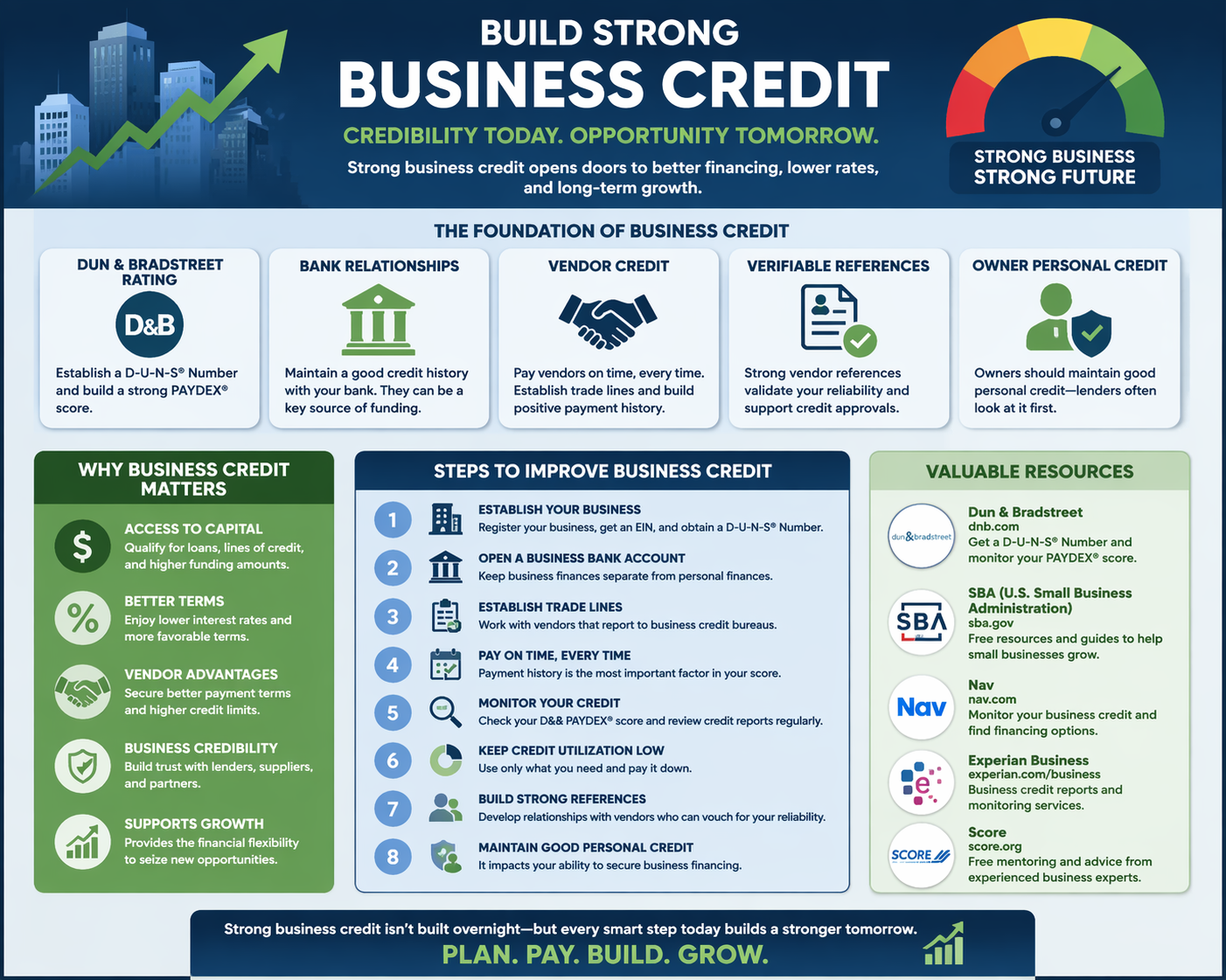
Business credit is more than just a number—it’s a financial reputation that tells lenders, vendors, partners, and insurers how reliably your company manages its obligations. A strong business credit profile opens doors to better financing, stronger supplier relationships, and lower costs throughout your operations. Without it, your business may have to rely on the personal credit of the owners, deal with higher interest rates, face denied contracts, denied loans and cash only  terms with vendors. All of the above can seriously hamper the success of  your business.

Every modern business that plans to grow should prioritize building and maintaining good credit for the company itself, not just the owners. Among the most recognized business credit frameworks is the one run by Dun & Bradstreet (D&B)—which provides a unique identifier and scores used worldwide to assess business creditworthiness. Let’s dive deeper.

Understanding Business Credit and D&B Ratings

Unlike personal credit scores (FICO scores), business credit reports are compiled and scored by specialized commercial credit bureaus like Dun & Bradstreet, Experian Business, and Equifax Business. These reports are based on:

  • Payment history with vendors and lenders
  • Public records (bankruptcies, liens, judgments)
  • Business attributes (age, industry classification, size)
  • Trade references from suppliers and financial institutions

Among these, D&B’s D-U-N-S® number serves as a global business identifier and a centralized way for third parties to look you up. This nine-digit number is free to obtain and essential if you want your company to be visible in the D&B system.

D&B also calculates credit scores such as the PAYDEX® Score, which focuses specifically on how promptly your business pays bills—payments on time (or early) significantly bolster your score.

The Strategic Importance of Business Credit

Click image for full size

Here’s why business credit should be a priority from Day One:

1. Easier Access to Capital

Banks and lenders evaluate business credit when deciding whether to offer loans or lines of credit. A good credit profile means faster approvals and lower interest rates.

2. Better Supplier & Vendor Terms

Many suppliers offer net-30, net-60, or net-90 payment terms. Vendors check business credit before extending trade terms; a strong credit file can increase your credit limits or qualify you for better pricing.

3. Reduced Personal Liability

When your business has its own credit identity and history, lenders and trade partners are more likely to consider the company’s creditworthiness rather than demanding personal guarantees from the owners.

4. Competitive Advantage

Winning bids, contracting with larger customers, or entering new markets often requires proof of financial stability. Solid business credit signals trustworthiness and financial discipline.

5. Lower Insurance and Lease Costs

Some insurers and landlords review business credit before setting premiums or lease terms. Strong credit can lead to lower costs over time.

Core Steps to Build and Improve Business Credit

Below is a step-by-step framework that incorporates proven best practices and widely recommended resources.

1. Separate Your Business Identity

Form a formal business structure, such as an LLC or corporation. Doing so separates your personal finances from the business, giving the company its own credit identity.

2. Obtain a Federal Employer Identification Number (EIN)

An EIN functions like a Social Security number for your business and is required for bank accounts, tax filings, and many credit applications.

3. Open a Business Bank Account

A dedicated business checking account establishes your financial footprint and supports future lending decisions. Consistent bank activity helps lenders verify your business’s stability.

4. Register for a D-U-N-S Number

Apply for your D&B number to start creating your commercial credit profile. Potential partners and lenders often request this before extending credit.

5. Establish Trade Accounts That Report

Work with vendors that report to business credit bureaus. Ask them before signing contracts which bureaus they report to and prioritize those that report to D&B, Experian, and Equifax. On-time payments are one of the strongest drivers of good business credit.

6. Open Business Credit Cards & Lines of Credit

Using business credit cards that report to the major bureaus reinforces positive payment data. Keep balances low relative to your credit limits and pay them on time.

7. Pay Early or On Time

Payment history is the single most influential factor in most business credit scoring models. If possible, pay invoices early rather than just on the due date.

8. Monitor Credit Reports Regularly

Review your business credit reports from D&B, Experian, and Equifax often. Correct errors quickly; inaccuracies can harm your score. Some banks offer free monitoring tools, and third-party services can help alert you to changes.

9. Avoid Negative Public Records

Judgments, liens, and bankruptcies can severely damage your credit profile and remain on reports for years. Address these proactively if they arise.

10. Build Personal Credit

While business credit stands apart, personal credit still influences your ability to secure funding—especially in the early years. Maintaining strong personal credit supports business credit applications and influences certain scoring models like the FICO SBSS used by loans.

Mistakes to Avoid

Even when you follow good practices, missteps can harm your credit progress:

  • Failing to update business information with credit bureaus can leave your file incomplete or stale.
  • Mixing personal and business finances blurs your credit picture and complicates reporting.
  • Not verifying which vendors report credit data; paying vendors who don’t report doesn’t help build credit.
  • High credit utilization on business lines can signal risk even if payments are on time.
  • Relying solely on one bureau; different creditors may pull from different reporting agencies.

Useful Resources

Below are some resources business owners can use to build or monitor their credit:

  • S. Small Business Administration (SBA) – Guidance on establishing and managing business credit.
  • Dun & Bradstreet Credit Monitoring Tools – Tools for managing D&B profiles and submitting trade references.
  • com – While focused on consumer credit, it’s a resource for personal credit monitoring.
  • Business credit services like Nav, Experian Business, Equifax Business reports, and third-party monitoring platforms.

Conclusion

Business credit is not optional—it’s a foundational component of financial strategy. Whether you’re launching a startup or scaling a mature enterprise, cultivating a strong business credit profile gives you access to capital, better supplier terms, lower risk, and greater strategic flexibility. Starting with the steps above, monitoring regularly, and avoiding common pitfalls will help you build a resilient, credible business credit history that supports growth for years to come.

All articles submitted by author are for subject matter discussion and are not financial advice.


The Real Reason Hospitals Lose Money on Denials

Hospitals don’t lose millions from denials because denials exist.
They lose millions because denial ownership is broken.

Most health systems unintentionally create these patterns:

  • Billing thinks denials are coding’s problem
  • Coding thinks denials are documentation’s problem
  • Documentation thinks denials are compliance’s problem
  • Compliance thinks denials are “payer games”

And leadership thinks the teams will magically figure it out together.

They don’t.

Denial management fails for three reasons:    

1️⃣  No defined owner per denial type
CO-16 isn’t the same as CO-18 or CO-197.
Yet most orgs treat “denials” as one bucket.

2️⃣  No cadence discipline
A denial touched every 14 days is a denial destined for aging.

3️⃣  No feedback loop

If coding errors don’t reach coders…
If eligibility errors don’t reach scheduling…
Denials repeat forever.

Denials aren’t a symptom.
They’re a report card.

And most organizations don’t want to look at the grade.

By Anoop Sivadasan

CEO, Wave Online 


Medical Leadership in 2026: What You’re Avoiding — and What You Must Build

By Michael Loschke, ARISTA Advisors | For Physicians, CEOs & Practice Administrators

The most pressing threat to your practice isn’t reimbursement cuts or staffing shortages. It’s leadership abdication — the quiet habit of avoiding the obligations that only you can fulfill.

The 3 Obligations Leaders Most Often Abdicate

  1. Defining and Defending Culture Most leaders leave culture to chance. When no one names the values, the team invents them — and rarely in ways that serve patients or performance. Culture is not an HR function. It is your most powerful retention tool, and it requires your voice. If you can’t easily and frequently witness the values on a daily basis, there is work to do.
  2. Having Honest Performance Conversations Physicians and administrators routinely tolerate underperformance, conflict avoidance masquerading as “keeping the peace.” We understand the fear and staffing shortage. Still, the cost is enormous: high performers disengage when mediocrity goes unchallenged. Direct, compassionate feedback is a leadership duty, not a personality trait.
  3. Casting a Compelling Vision Your team is burned out and underwater. They don’t just need a paycheck — they need to know why the work matters and where the practice is headed. Leaders who skip vision-setting leave their people in a fog of task-completion with no larger purpose to anchor them. Imagine endlessly hiking, not knowing the direction, purpose or if there’s a summit!


The Skills Leaders Must Build in 2026

  1. Psychological Safety Fluency Teams that feel safe to speak up make fewer errors and stay longer. Learning to model vulnerability and reward candor is now a clinical quality issue, not just a culture nicety. When members don’t feel safe, they sacrifice commitments, goals, and relationships on their way out the door.
  2. Adaptive Communication A Gen Z medical assistant and a Baby Boomer surgeon need different things from you. Leaders who can flex their communication style — across generations, roles, and stress levels — build cohesion where others build resentment. With five generations in the workforce, this requires NEW training, practice and commitment.
  3. Strategic Storytelling Data doesn’t inspire people. Stories do. The ability to translate your practice’s numbers, mission, and direction into a narrative that moves people is the difference between leaders who retain talent and those who constantly recruit it. This is NOT a natural skill set, especially for left-brained academics. It is essential in an increasingly crowded marketplace.

The practices that will thrive in 2026 won’t just be the most efficient — they’ll be the ones led by people willing to show up fully for the human side of leadership.


Michael Loschke is Chairman of Arista Advisors LLC.  He collaborates with CEOs and leadership to improve organizational health, executive performance and work/life balance.  Contact him for planning, speaking, diagnostic or coaching projects www.arista-advisors.com or michael@arista-advisors.com or 209-988-2000.