The American Heart Association Leaders of Impact initiative is a national leadership and fundraising campaign that empowers influential community leaders to champion heart health. Participants build teams, educate communities, advocate for healthier lives, and raise critical funds to support the Association’s lifesaving mission and drive meaningful local and national impact.
Our friend Dr. Harpal Singh has been selected as Leader of Impact Nominee from City of San Antonio by the American Heart Association. And he is currently working hard to help spread awareness on Heart Disease and to fund raise.
Please help Dr. Singh support this important cause. You can scan the QR code below to give.
Any donations from you are welcome!
(All, 100% donations goes to American Heart Association)
Join the San Antonio Technology Center (SATC) on January 14th, 2027* from 4:30 to 6:30 pm for an evening bringing together San Antonio’s medical, biotech, and life-sciences community.
The event will bring together physicians, researchers, diagnostic and medical-device companies, biotech entrepreneurs, laboratory professionals, and other leaders in the healthcare community for an opportunity to meet, exchange ideas, and explore new opportunities for collaboration.
Enjoy food, drinks, and good conversation while connecting with others who are helping shape the future of healthcare and life sciences in San Antonio.
Come meet your neighbors in the medical and biotech community—and discover what we can accomplish together.
*Please note, in case you have seen references to the event in other sources, that it has been changed from its original date of November 5th to the new date of January 14th.
After nearly two decades in healthcare finance, I’ve learned that financial crises rarely begin as financial problems. They begin as operational trends that go unnoticed long enough to become financial problems.
A decline in patient volume. A gradual increase in labor costs. Changes in payer mix. A physician whose productivity has plateaued. None of these events happen overnight, and none of them are immediately obvious on a monthly income statement. By the time the financial reports clearly reflect the impact, leaders are often forced into reactive decisions—freezing hiring, delaying investments, or making broad cost reductions that could have been avoided with earlier visibility. That’s because financial statements are designed to report what has already happened. They are essential, but they aren’t designed to answer the questions executives wrestle with every day: Why are margins changing? Which parts of the business are creating value? Where are we headed six months from now if nothing changes? Those answers come from connecting financial data with operational performance and turning information into insight.
As healthcare continues to evolve, that distinction has never been more important. Organizations are navigating reimbursement pressure, workforce shortages, rising costs, regulatory complexity, and growing expectations from patients and providers alike. Every decision carries financial consequences, but those consequences aren’t always visible until it’s too late. Whether you’re leading a physician practice, an ambulatory surgery center, a dental group, a healthcare technology company, or another healthcare business, proactive financial leadership creates a tremendous advantage. It means understanding the story behind the numbers, identifying risks before they become emergencies, and evaluating opportunities before making significant investments. That’s why many growing organizations are turning to fractional CFOs—gaining executive-level financial strategy without the commitment of a full-time executive. The objective isn’t simply producing accurate reports; it’s helping leadership make better decisions with greater confidence.
The strongest organizations I’ve worked with weren’t defined by perfect market conditions or unlimited resources. They were defined by leaders who consistently asked better questions. They wanted to understand not only what had happened, but what was likely to happen next and what actions they could take today to influence tomorrow’s results. When finance becomes a strategic partner instead of a historical record, organizations are better equipped to grow, adapt, and fulfill their mission. In healthcare, where every business decision ultimately influences the care we provide, that kind of insight isn’t just valuable—it’s essential.
July marks one year of publishing our very first monthly HLSAnewsletter. It has been challenging, a great learning experience, quite a bit of fun and very rewarding. It would also not have been possible without the inspiration and guidance we received from our mentor, Michael Loschke of Arista Advisors, to whom we are incredibly grateful. We (our board) had been talking for some time about doing a newsletter to expand our community outreach, and Michael was the catalyst that made that happen. We wanted to provide added value to our sponsors while also sharing some great information from some of the very smart and experienced individuals we have met through our networking events.
We have been hosting our monthly mixers and special events for well over a decade now with one mission in mind, to thoughtfully connect healthcare professionals as a means to grow connections and opportunities. Most people think of that when they think of networking- you’re looking for new business, new clients, maybe a new job- and those are reasonable and practical goals. But over the years we have also forged some very meaningful connections and friendships, and learned a lot about business in San Antonio.
If asked to point to one source of inspiration for starting a networking group, I would have to point to Johnny Johnson. His real name was Phil Johnson, but I always remember him being introduced as “Johnny” at our regional ACHE conferences in the mid-90s when he was the CEO of what was then McKenna Hospital in New Braunfels. Johnny was of course a fellow in ACHE and had also enjoyed a distinguished health administration career in the US Army, rising to the rank of Colonel before returning to civilian life. He was also a huge proponent of networking and always brought very sizeable stacks of business cards in rubber bands (this was in the earliest days of the internet) to the conference podium to drive home his points when he spoke about its importance to our careers. He would say it is something you have to do continually, a career discipline that can be rewarding in ways beyond the next job lead.
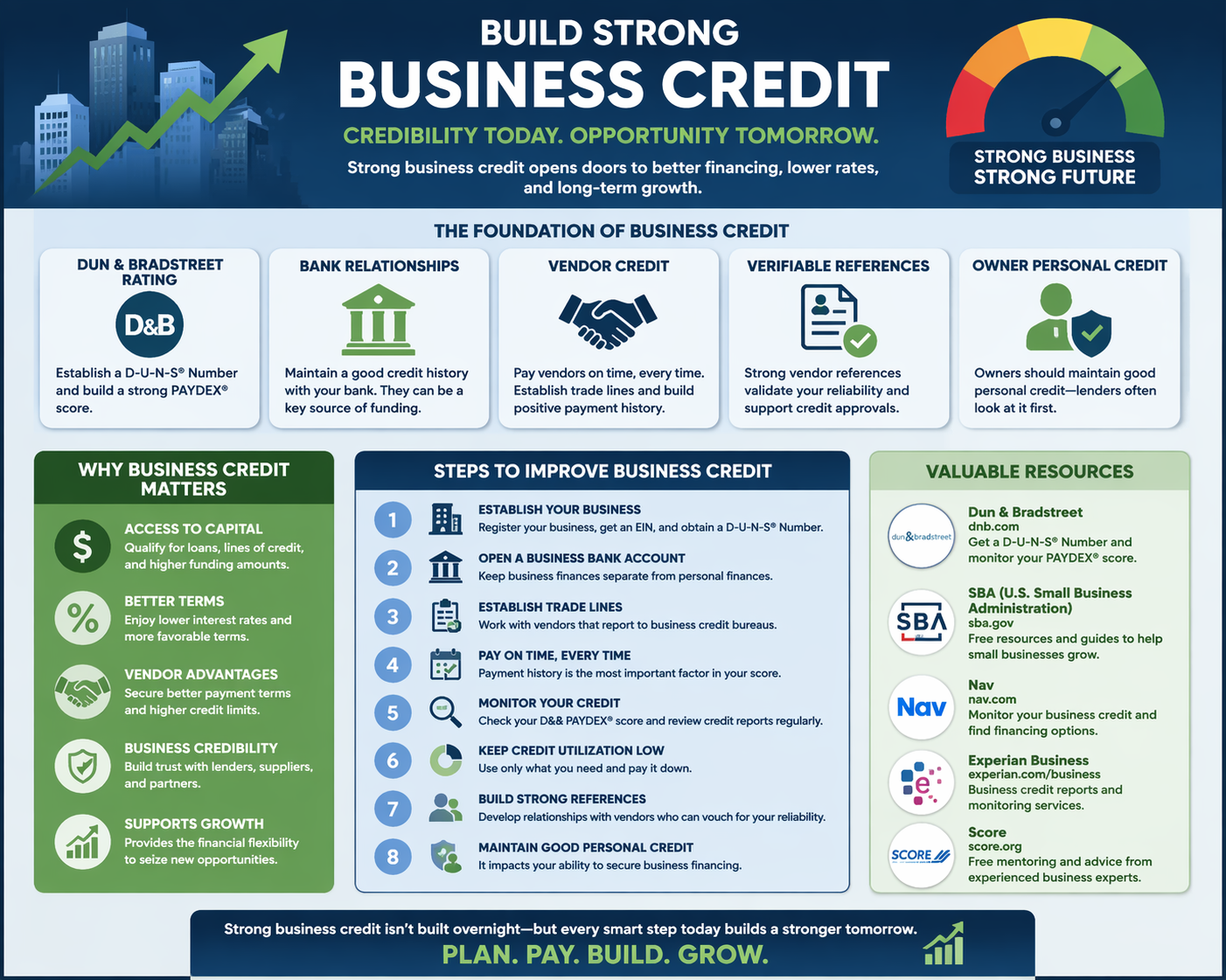
Business credit is more than just a number—it’s a financial reputation that tells lenders, vendors, partners, and insurers how reliably your company manages its obligations. A strong business credit profile opens doors to better financing, stronger supplier relationships, and lower costs throughout your operations. Without it, your business may have to rely on the personal credit of the owners, deal with higher interest rates, face denied contracts, denied loans and cash only terms with vendors. All of the above can seriously hamper the success of your business.
Every modern business that plans to grow should prioritize building and maintaining good credit for the company itself, not just the owners. Among the most recognized business credit frameworks is the one run by Dun & Bradstreet (D&B)—which provides a unique identifier and scores used worldwide to assess business creditworthiness. Let’s dive deeper.
Understanding Business Credit and D&B Ratings
Unlike personal credit scores (FICO scores), business credit reports are compiled and scored by specialized commercial credit bureaus like Dun & Bradstreet, Experian Business, and Equifax Business. These reports are based on:
Payment history with vendors and lenders
Public records (bankruptcies, liens, judgments)
Business attributes (age, industry classification, size)
Trade references from suppliers and financial institutions
Among these, D&B’s D-U-N-S® number serves as a global business identifier and a centralized way for third parties to look you up. This nine-digit number is free to obtain and essential if you want your company to be visible in the D&B system.
D&B also calculates credit scores such as the PAYDEX® Score, which focuses specifically on how promptly your business pays bills—payments on time (or early) significantly bolster your score.
The Strategic Importance of Business Credit
Click image for full size
Here’s why business credit should be a priority from Day One:
1. Easier Access to Capital
Banks and lenders evaluate business credit when deciding whether to offer loans or lines of credit. A good credit profile means faster approvals and lower interest rates.
2. Better Supplier & Vendor Terms
Many suppliers offer net-30, net-60, or net-90 payment terms. Vendors check business credit before extending trade terms; a strong credit file can increase your credit limits or qualify you for better pricing.
3. Reduced Personal Liability
When your business has its own credit identity and history, lenders and trade partners are more likely to consider the company’s creditworthiness rather than demanding personal guarantees from the owners.
4. Competitive Advantage
Winning bids, contracting with larger customers, or entering new markets often requires proof of financial stability. Solid business credit signals trustworthiness and financial discipline.
5. Lower Insurance and Lease Costs
Some insurers and landlords review business credit before setting premiums or lease terms. Strong credit can lead to lower costs over time.
Core Steps to Build and Improve Business Credit
Below is a step-by-step framework that incorporates proven best practices and widely recommended resources.
1. Separate Your Business Identity
Form a formal business structure, such as an LLC or corporation. Doing so separates your personal finances from the business, giving the company its own credit identity.
2. Obtain a Federal Employer Identification Number (EIN)
An EIN functions like a Social Security number for your business and is required for bank accounts, tax filings, and many credit applications.
3. Open a Business Bank Account
A dedicated business checking account establishes your financial footprint and supports future lending decisions. Consistent bank activity helps lenders verify your business’s stability.
4. Register for a D-U-N-S Number
Apply for your D&B number to start creating your commercial credit profile. Potential partners and lenders often request this before extending credit.
5. Establish Trade Accounts That Report
Work with vendors that report to business credit bureaus. Ask them before signing contracts which bureaus they report to and prioritize those that report to D&B, Experian, and Equifax. On-time payments are one of the strongest drivers of good business credit.
6. Open Business Credit Cards & Lines of Credit
Using business credit cards that report to the major bureaus reinforces positive payment data. Keep balances low relative to your credit limits and pay them on time.
7. Pay Early or On Time
Payment history is the single most influential factor in most business credit scoring models. If possible, pay invoices early rather than just on the due date.
8. Monitor Credit Reports Regularly
Review your business credit reports from D&B, Experian, and Equifax often. Correct errors quickly; inaccuracies can harm your score. Some banks offer free monitoring tools, and third-party services can help alert you to changes.
9. Avoid Negative Public Records
Judgments, liens, and bankruptcies can severely damage your credit profile and remain on reports for years. Address these proactively if they arise.
10. Build Personal Credit
While business credit stands apart, personal credit still influences your ability to secure funding—especially in the early years. Maintaining strong personal credit supports business credit applications and influences certain scoring models like the FICO SBSS used by loans.
Mistakes to Avoid
Even when you follow good practices, missteps can harm your credit progress:
Failing to update business information with credit bureaus can leave your file incomplete or stale.
Mixing personal and business finances blurs your credit picture and complicates reporting.
Not verifying which vendors report credit data; paying vendors who don’t report doesn’t help build credit.
High credit utilization on business lines can signal risk even if payments are on time.
Relying solely on one bureau; different creditors may pull from different reporting agencies.
Useful Resources
Below are some resources business owners can use to build or monitor their credit:
S. Small Business Administration (SBA) – Guidance on establishing and managing business credit.
Dun & Bradstreet Credit Monitoring Tools – Tools for managing D&B profiles and submitting trade references.
com – While focused on consumer credit, it’s a resource for personal credit monitoring.
Business credit services like Nav, Experian Business, Equifax Business reports, and third-party monitoring platforms.
Conclusion
Business credit is not optional—it’s a foundational component of financial strategy. Whether you’re launching a startup or scaling a mature enterprise, cultivating a strong business credit profile gives you access to capital, better supplier terms, lower risk, and greater strategic flexibility. Starting with the steps above, monitoring regularly, and avoiding common pitfalls will help you build a resilient, credible business credit history that supports growth for years to come.
All articles submitted by author are for subject matter discussion and are not financial advice.
By Michael Loschke, ARISTA Advisors | For Physicians, CEOs & Practice Administrators
The most pressing threat to your practice isn’t reimbursement cuts or staffing shortages. It’s leadership abdication — the quiet habit of avoiding the obligations that only you can fulfill.
The 3 Obligations Leaders Most Often Abdicate
Defining and Defending Culture Most leaders leave culture to chance. When no one names the values, the team invents them — and rarely in ways that serve patients or performance. Culture is not an HR function. It is your most powerful retention tool, and it requires your voice. If you can’t easily and frequently witness the values on a daily basis, there is work to do.
Having Honest Performance Conversations Physicians and administrators routinely tolerate underperformance, conflict avoidance masquerading as “keeping the peace.” We understand the fear and staffing shortage. Still, the cost is enormous: high performers disengage when mediocrity goes unchallenged. Direct, compassionate feedback is a leadership duty, not a personality trait.
Casting a Compelling Vision Your team is burned out and underwater. They don’t just need a paycheck — they need to know why the work matters and where the practice is headed. Leaders who skip vision-setting leave their people in a fog of task-completion with no larger purpose to anchor them. Imagine endlessly hiking, not knowing the direction, purpose or if there’s a summit!
The Skills Leaders Must Build in 2026
Psychological Safety Fluency Teams that feel safe to speak up make fewer errors and stay longer. Learning to model vulnerability and reward candor is now a clinical quality issue, not just a culture nicety. When members don’t feel safe, they sacrifice commitments, goals, and relationships on their way out the door.
Adaptive Communication A Gen Z medical assistant and a Baby Boomer surgeon need different things from you. Leaders who can flex their communication style — across generations, roles, and stress levels — build cohesion where others build resentment. With five generations in the workforce, this requires NEW training, practice and commitment.
Strategic Storytelling Data doesn’t inspire people. Stories do. The ability to translate your practice’s numbers, mission, and direction into a narrative that moves people is the difference between leaders who retain talent and those who constantly recruit it. This is NOT a natural skill set, especially for left-brained academics. It is essential in an increasingly crowded marketplace.
The practices that will thrive in 2026 won’t just be the most efficient — they’ll be the ones led by people willing to show up fully for the human side of leadership.
Michael Loschke is Chairman of Arista Advisors LLC. He collaborates with CEOs and leadership to improve organizational health, executive performance and work/life balance. Contact him for planning, speaking, diagnostic or coaching projects www.arista-advisors.com or michael@arista-advisors.com or 209-988-2000.
HLSA has adopted some local charities to promote to our members in an effort to highlight and support their incredible missions. From time to time, we will be inviting their representatives to our events to learn more about their service to others.
The Poco Loco Team for the Walk to End Alzheimers. The Alzheimer’s Association Walk to End Alzheimer’s is the world’s largest fundraiser for Alzheimer’s care, support and research.
Ronald McDonald House Charities of San Antonio provides a safe and caring home away from home for the families of children receiving essential medical services in San Antonio, Texas. Families are stronger when they stay together.
Morgan’s Inclusion Initiative is more than a nonprofit organization; it’s a movement of inclusion. Our organization oversees five fully-inclusive, Ultra-AccessibleTM facilities where individuals of all ages and all abilities can come together for recreation and a better understanding of one another.