
Unlocking the Power of Strong Business Credit

By August Trevino

Commercial Strategist

Business credit is more than just a number—it’s a financial reputation that tells lenders, vendors, partners, and insurers how reliably your company manages its obligations. A strong business credit profile opens doors to better financing, stronger supplier relationships, and lower costs throughout your operations. Without it, your business may have to rely on the personal credit of the owners, deal with higher interest rates, face denied contracts, denied loans and cash only  terms with vendors. All of the above can seriously hamper the success of  your business.

Every modern business that plans to grow should prioritize building and maintaining good credit for the company itself, not just the owners. Among the most recognized business credit frameworks is the one run by Dun & Bradstreet (D&B)—which provides a unique identifier and scores used worldwide to assess business creditworthiness. Let’s dive deeper.

Understanding Business Credit and D&B Ratings

Unlike personal credit scores (FICO scores), business credit reports are compiled and scored by specialized commercial credit bureaus like Dun & Bradstreet, Experian Business, and Equifax Business. These reports are based on:

  • Payment history with vendors and lenders
  • Public records (bankruptcies, liens, judgments)
  • Business attributes (age, industry classification, size)
  • Trade references from suppliers and financial institutions

Among these, D&B’s D-U-N-S® number serves as a global business identifier and a centralized way for third parties to look you up. This nine-digit number is free to obtain and essential if you want your company to be visible in the D&B system.

D&B also calculates credit scores such as the PAYDEX® Score, which focuses specifically on how promptly your business pays bills—payments on time (or early) significantly bolster your score.

The Strategic Importance of Business Credit
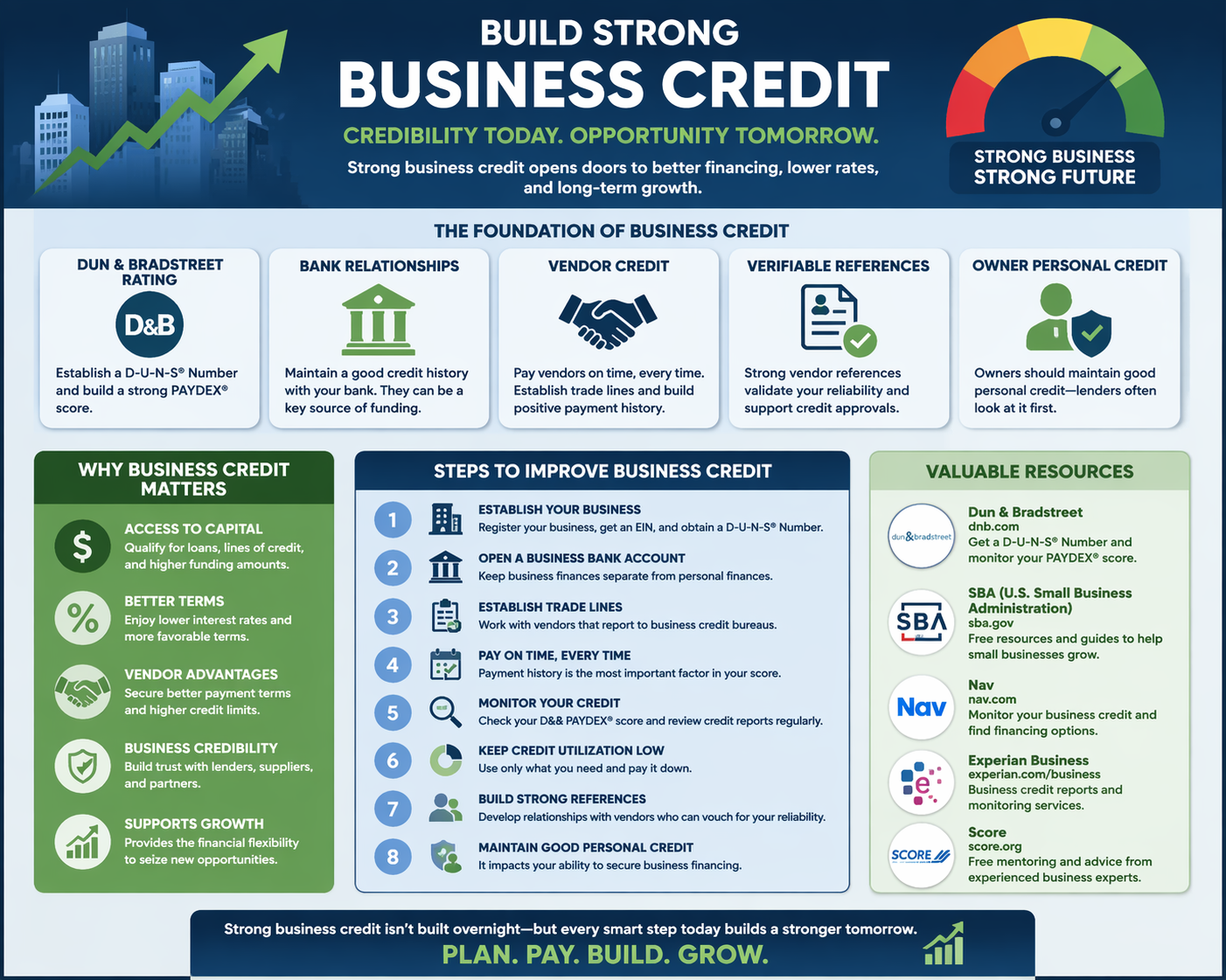
Click image for full size

Here’s why business credit should be a priority from Day One:

1. Easier Access to Capital

Banks and lenders evaluate business credit when deciding whether to offer loans or lines of credit. A good credit profile means faster approvals and lower interest rates.

2. Better Supplier & Vendor Terms

Many suppliers offer net-30, net-60, or net-90 payment terms. Vendors check business credit before extending trade terms; a strong credit file can increase your credit limits or qualify you for better pricing.

3. Reduced Personal Liability

When your business has its own credit identity and history, lenders and trade partners are more likely to consider the company’s creditworthiness rather than demanding personal guarantees from the owners.

4. Competitive Advantage

Winning bids, contracting with larger customers, or entering new markets often requires proof of financial stability. Solid business credit signals trustworthiness and financial discipline.

5. Lower Insurance and Lease Costs

Some insurers and landlords review business credit before setting premiums or lease terms. Strong credit can lead to lower costs over time.

Core Steps to Build and Improve Business Credit

Below is a step-by-step framework that incorporates proven best practices and widely recommended resources.

1. Separate Your Business Identity

Form a formal business structure, such as an LLC or corporation. Doing so separates your personal finances from the business, giving the company its own credit identity.

2. Obtain a Federal Employer Identification Number (EIN)

An EIN functions like a Social Security number for your business and is required for bank accounts, tax filings, and many credit applications.

3. Open a Business Bank Account

A dedicated business checking account establishes your financial footprint and supports future lending decisions. Consistent bank activity helps lenders verify your business’s stability.

4. Register for a D-U-N-S Number

Apply for your D&B number to start creating your commercial credit profile. Potential partners and lenders often request this before extending credit.

5. Establish Trade Accounts That Report

Work with vendors that report to business credit bureaus. Ask them before signing contracts which bureaus they report to and prioritize those that report to D&B, Experian, and Equifax. On-time payments are one of the strongest drivers of good business credit.

6. Open Business Credit Cards & Lines of Credit

Using business credit cards that report to the major bureaus reinforces positive payment data. Keep balances low relative to your credit limits and pay them on time.

7. Pay Early or On Time

Payment history is the single most influential factor in most business credit scoring models. If possible, pay invoices early rather than just on the due date.

8. Monitor Credit Reports Regularly

Review your business credit reports from D&B, Experian, and Equifax often. Correct errors quickly; inaccuracies can harm your score. Some banks offer free monitoring tools, and third-party services can help alert you to changes.

9. Avoid Negative Public Records

Judgments, liens, and bankruptcies can severely damage your credit profile and remain on reports for years. Address these proactively if they arise.

10. Build Personal Credit

While business credit stands apart, personal credit still influences your ability to secure funding—especially in the early years. Maintaining strong personal credit supports business credit applications and influences certain scoring models like the FICO SBSS used by loans.

Mistakes to Avoid

Even when you follow good practices, missteps can harm your credit progress:

  • Failing to update business information with credit bureaus can leave your file incomplete or stale.
  • Mixing personal and business finances blurs your credit picture and complicates reporting.
  • Not verifying which vendors report credit data; paying vendors who don’t report doesn’t help build credit.
  • High credit utilization on business lines can signal risk even if payments are on time.
  • Relying solely on one bureau; different creditors may pull from different reporting agencies.

Useful Resources

Below are some resources business owners can use to build or monitor their credit:

  • S. Small Business Administration (SBA) – Guidance on establishing and managing business credit.
  • Dun & Bradstreet Credit Monitoring Tools – Tools for managing D&B profiles and submitting trade references.
  • com – While focused on consumer credit, it’s a resource for personal credit monitoring.
  • Business credit services like Nav, Experian Business, Equifax Business reports, and third-party monitoring platforms.

Conclusion

Business credit is not optional—it’s a foundational component of financial strategy. Whether you’re launching a startup or scaling a mature enterprise, cultivating a strong business credit profile gives you access to capital, better supplier terms, lower risk, and greater strategic flexibility. Starting with the steps above, monitoring regularly, and avoiding common pitfalls will help you build a resilient, credible business credit history that supports growth for years to come.

All articles submitted by author are for subject matter discussion and are financial advice.


Navigating Alligator Alley: In-Home Care

As an in-home health care business owner, the prospect of growing your company from $1 million to $10 million in revenue over the next 5 years is an exciting but daunting challenge. While the potential rewards in terms of impact, influence, and financial gain are significant, there are several key obstacles you’ll need to overcome to achieve this level of rapid growth.  Learning how to navigate Alligator Alley is essential.

The Top 5 Obstacles

  1. Hiring and Retaining Top Talent Finding, training, and keeping high-quality caregivers is absolutely critical but notoriously difficult in the in-home health industry. With high turnover rates and fierce competition for skilled workers, building a stable, engaged workforce is perhaps the biggest hurdle to scaling. Offering competitive wages, robust benefits, and a positive, supportive company culture are essential to attract and retain the best talent. Investing in robust recruitment, onboarding, and training programs is a must. And going beyond just compensation to foster a true sense of belonging, purpose, and growth opportunity for your employees is key.
  2. Operational Inefficiencies Scaling an in-home care business requires streamlining processes, optimizing scheduling and routing, and leveraging technology to improve efficiency across the board. Outdated systems, manual workflows, and siloed data will quickly become major bottlenecks as you grow. Investing in the right tools and infrastructure to automate and integrate key operations is crucial. This includes everything from electronic health records and scheduling software to business intelligence dashboards and robotic process automation.
  3. Cash Flow Management Rapid expansion requires significant upfront investment in areas like marketing, hiring, and infrastructure. Maintaining positive cash flow to fund this growth while waiting for insurance reimbursements can be a major challenge. Careful financial planning, access to capital, and efficient billing and collections processes are vital. Strategies like factoring, lines of credit, and diversifying your payer mix can all help manage cash flow. And having a dedicated finance team to oversee budgeting, forecasting, and working capital is essential.
  4. Regulatory Compliance The in-home health industry is highly regulated, with complex and ever-changing rules around licensing, training, billing, and more. Staying 100% compliant as you scale your business is critical but also extremely resource-intensive. Building a culture of compliance and having the right systems in place to manage regulatory requirements is key. This includes things like automated compliance tracking, regular audits, and dedicated compliance officers or teams.
  5. Brand Awareness and Referrals Building a strong brand identity and referral network is essential to drive consistent client acquisition at scale. This requires strategic marketing, sales, and partnership efforts that many smaller in-home care providers struggle with. Investing in your brand, developing a lead generation engine, and cultivating referral relationships are musts. From SEO and PPC to content marketing and community engagement, a multi-faceted approach to building visibility and credibility in your market is vital.

To overcome these obstacles, the essential strategy is to intentionally blend a “clan” culture focused on employee engagement and a “hierarchy” culture emphasizing operational efficiency and compliance. This dual approach allows you to maintain the personal, family-like atmosphere that attracts top caregivers while also building the systems, processes, and infrastructure needed to scale.

On the “clan” side, prioritizing things like training, career development, recognition programs, and team-building activities helps foster a sense of community and loyalty among your workforce. Empowering employees, soliciting their input, and creating opportunities for advancement are key. This creates an environment where your caregivers feel valued, supported, and invested in the company’s success.

On the “hierarchy” side, implementing standardized workflows, leveraging technology, and establishing clear policies and procedures around compliance, billing, and other key functions creates the operational discipline required for rapid, sustainable growth. Strong leadership, accountability measures, and data-driven decision making are critical. This brings the necessary structure, efficiency, and consistency to scale your business without sacrificing the personal touch.

By getting the right people, processes, and culture in place – blending the best of both the “clan” and “hierarchy” approaches – in-home care providers can absolutely achieve the dream of $10 million in revenue within 5 years. It will take hard work, focus, and commitment, but the payoff in terms of growth, impact, and financial rewards can be truly transformative for your business and the communities you serve.

The key is finding the right balance. Lean too far into the “clan” culture and you risk becoming disorganized, inefficient, and unable to scale. But go too far into the “hierarchy” and you may lose the personal touch, employee engagement, and innovative spirit that makes your in-home care business special in the first place.

Striking that balance requires intentional, thoughtful leadership. It means investing in both your people and your processes – creating an environment where your caregivers feel empowered and your operations run like a well-oiled machine. It’s about building the infrastructure to grow while preserving the heart and soul of your organization.

With the right strategies in place to overcome the top obstacles, in-home health care providers can absolutely achieve remarkable growth, reaching $10 million in revenue or more within just 5 years. It won’t be easy, but the potential rewards – for your business, your employees, and the families you serve – make it a worthy pursuit. So get ready to scale, my friends. The future of in-home care is bright.


Michael Loschke is Chairman of ARISTA Advisors LLC.  He enjoys collaborating with CEOs to improve organizational health, executive performance and work/life balance.  Subscribe to his free newsletter at arista-advisors.com or contact him with questions at michael@arista-advisors.com or 209-988-2000.

The Real Reason Hospitals Lose Money on Denials

Hospitals don’t lose millions from denials because denials exist.
They lose millions because denial ownership is broken.

Most health systems unintentionally create these patterns:

  • Billing thinks denials are coding’s problem
  • Coding thinks denials are documentation’s problem
  • Documentation thinks denials are compliance’s problem
  • Compliance thinks denials are “payer games”

And leadership thinks the teams will magically figure it out together.

They don’t.

Denial management fails for three reasons:    

1️⃣  No defined owner per denial type
CO-16 isn’t the same as CO-18 or CO-197.
Yet most orgs treat “denials” as one bucket.

2️⃣  No cadence discipline
A denial touched every 14 days is a denial destined for aging.

3️⃣  No feedback loop

If coding errors don’t reach coders…
If eligibility errors don’t reach scheduling…
Denials repeat forever.

Denials aren’t a symptom.
They’re a report card.

And most organizations don’t want to look at the grade.

By Anoop Sivadasan

CEO, Wave Online