
Commercial Strategist
Business credit is more than just a number—it’s a financial reputation that tells lenders, vendors, partners, and insurers how reliably your company manages its obligations. A strong business credit profile opens doors to better financing, stronger supplier relationships, and lower costs throughout your operations. Without it, your business may have to rely on the personal credit of the owners, deal with higher interest rates, face denied contracts, denied loans and cash only terms with vendors. All of the above can seriously hamper the success of your business.
Every modern business that plans to grow should prioritize building and maintaining good credit for the company itself, not just the owners. Among the most recognized business credit frameworks is the one run by Dun & Bradstreet (D&B)—which provides a unique identifier and scores used worldwide to assess business creditworthiness. Let’s dive deeper.
Understanding Business Credit and D&B Ratings
Unlike personal credit scores (FICO scores), business credit reports are compiled and scored by specialized commercial credit bureaus like Dun & Bradstreet, Experian Business, and Equifax Business. These reports are based on:
- Payment history with vendors and lenders
- Public records (bankruptcies, liens, judgments)
- Business attributes (age, industry classification, size)
- Trade references from suppliers and financial institutions
Among these, D&B’s D-U-N-S® number serves as a global business identifier and a centralized way for third parties to look you up. This nine-digit number is free to obtain and essential if you want your company to be visible in the D&B system.
D&B also calculates credit scores such as the PAYDEX® Score, which focuses specifically on how promptly your business pays bills—payments on time (or early) significantly bolster your score.
The Strategic Importance of Business Credit
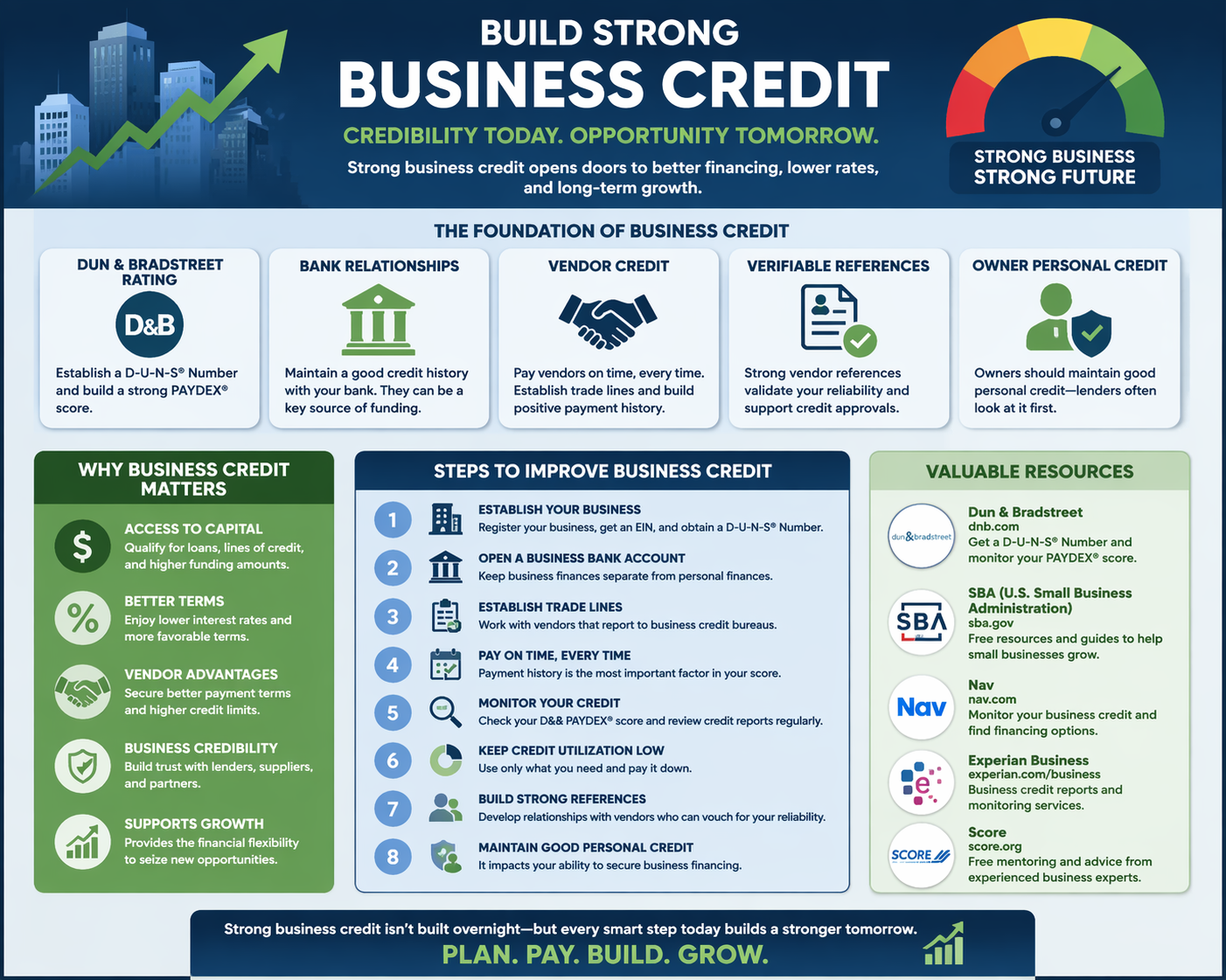
Here’s why business credit should be a priority from Day One:
1. Easier Access to Capital
Banks and lenders evaluate business credit when deciding whether to offer loans or lines of credit. A good credit profile means faster approvals and lower interest rates.
2. Better Supplier & Vendor Terms
Many suppliers offer net-30, net-60, or net-90 payment terms. Vendors check business credit before extending trade terms; a strong credit file can increase your credit limits or qualify you for better pricing.
3. Reduced Personal Liability
When your business has its own credit identity and history, lenders and trade partners are more likely to consider the company’s creditworthiness rather than demanding personal guarantees from the owners.
4. Competitive Advantage
Winning bids, contracting with larger customers, or entering new markets often requires proof of financial stability. Solid business credit signals trustworthiness and financial discipline.
5. Lower Insurance and Lease Costs
Some insurers and landlords review business credit before setting premiums or lease terms. Strong credit can lead to lower costs over time.
Core Steps to Build and Improve Business Credit
Below is a step-by-step framework that incorporates proven best practices and widely recommended resources.
1. Separate Your Business Identity
Form a formal business structure, such as an LLC or corporation. Doing so separates your personal finances from the business, giving the company its own credit identity.
2. Obtain a Federal Employer Identification Number (EIN)
An EIN functions like a Social Security number for your business and is required for bank accounts, tax filings, and many credit applications.
3. Open a Business Bank Account
A dedicated business checking account establishes your financial footprint and supports future lending decisions. Consistent bank activity helps lenders verify your business’s stability.
4. Register for a D-U-N-S Number
Apply for your D&B number to start creating your commercial credit profile. Potential partners and lenders often request this before extending credit.
5. Establish Trade Accounts That Report
Work with vendors that report to business credit bureaus. Ask them before signing contracts which bureaus they report to and prioritize those that report to D&B, Experian, and Equifax. On-time payments are one of the strongest drivers of good business credit.
6. Open Business Credit Cards & Lines of Credit
Using business credit cards that report to the major bureaus reinforces positive payment data. Keep balances low relative to your credit limits and pay them on time.
7. Pay Early or On Time
Payment history is the single most influential factor in most business credit scoring models. If possible, pay invoices early rather than just on the due date.
8. Monitor Credit Reports Regularly
Review your business credit reports from D&B, Experian, and Equifax often. Correct errors quickly; inaccuracies can harm your score. Some banks offer free monitoring tools, and third-party services can help alert you to changes.
9. Avoid Negative Public Records
Judgments, liens, and bankruptcies can severely damage your credit profile and remain on reports for years. Address these proactively if they arise.
10. Build Personal Credit
While business credit stands apart, personal credit still influences your ability to secure funding—especially in the early years. Maintaining strong personal credit supports business credit applications and influences certain scoring models like the FICO SBSS used by loans.
Mistakes to Avoid
Even when you follow good practices, missteps can harm your credit progress:
- Failing to update business information with credit bureaus can leave your file incomplete or stale.
- Mixing personal and business finances blurs your credit picture and complicates reporting.
- Not verifying which vendors report credit data; paying vendors who don’t report doesn’t help build credit.
- High credit utilization on business lines can signal risk even if payments are on time.
- Relying solely on one bureau; different creditors may pull from different reporting agencies.
Useful Resources
Below are some resources business owners can use to build or monitor their credit:
- S. Small Business Administration (SBA) – Guidance on establishing and managing business credit.
- Dun & Bradstreet Credit Monitoring Tools – Tools for managing D&B profiles and submitting trade references.
- com – While focused on consumer credit, it’s a resource for personal credit monitoring.
- Business credit services like Nav, Experian Business, Equifax Business reports, and third-party monitoring platforms.
Conclusion
Business credit is not optional—it’s a foundational component of financial strategy. Whether you’re launching a startup or scaling a mature enterprise, cultivating a strong business credit profile gives you access to capital, better supplier terms, lower risk, and greater strategic flexibility. Starting with the steps above, monitoring regularly, and avoiding common pitfalls will help you build a resilient, credible business credit history that supports growth for years to come.
All articles submitted by author are for subject matter discussion and are not financial advice.