When Healing Others Becomes a Way to Avoid Ourselves: The Quiet Cost of High Performance in Healthcare

If you work in healthcare—whether you’re a nurse, a doctor, a manager, or someone who works with data—you carry a lot of responsibility. People count on you for their health, safety, and care. And you’re probably really good at handling that pressure.

You’re used to pushing through tough days. You solve problems, stay late, and make hard decisions. You always show up. That’s what makes you great at your job.

But there’s something many people in healthcare quietly struggle with: perfectionism. The pressure to always do everything right and never make mistakes might seem like a strength. But it can also lead to something more serious—emotional fragility.

When you believe your worth depends on your performance, it can be exhausting. You might start to wonder if you’re ever doing enough. Over time, this stress can build up, and you may feel disconnected from yourself and the people around you.

Research shows that perfectionism is linked to higher risks of mental health problems, including depression and suicide. This doesn’t mean perfectionism always leads to those things—but it does mean we need to be aware of how much pressure we’re putting on ourselves.

In healthcare, it’s easy to tie your value to things that can be measured: how quickly you care for patients, how many tasks you complete, and how good your reviews are. But things like connection, reflection, and rest don’t show up on charts or dashboards—and yet, they’re just as important.

So we keep working. One more patient. One more meeting. One more emergency. And slowly, we lose touch with the things that bring us peace, joy, and meaning.

That’s when the real cost shows up.

We become leaders who are respected but feel alone. Healthcare workers who are great at their jobs but drained. Parents or partners who are present, but distant. We care for everyone else but forget to care for ourselves. I know this because I have been there: carrying work performance stress to my kids or not being present in meetings because I feel like I am failing at managing my house.

But here’s the truth: your value isn’t in how well you do things. It’s in who you already are.

To live a life that’s not just sustainable—but also satisfying—we need more than hard work and success. We need emotional resilience: the ability to stay grounded, connected, and strong even when life gets hard. Really, the key to emotional resilience is the ability to accept grace.

Moving from emotional fragility to emotional resilience is the key to staying well in a demanding field like healthcare. It helps you stay present in your relationships, enjoy your work more, and remember why you chose this path in the first place.

Want to know where you stand? Take our free Emotional Fragility Quiz—a simple way to check in with yourself and start building more resilience in your life.

👉 [Take the free quiz now]

You don’t have to carry everything alone. And you don’t have to be perfect to be enough.

by Dr. Uejin Kim, MD

www.uejinkim.com


O’Connor, R. C. (2010). The relations between perfectionism and suicidality: A systematic review. Suicide and Life‑Threatening Behavior, 37(6), 698–714. https://doi.org/10.1521/suli.2007.37.6.698 Wiley Online LibraryUniversity of Stirling

Smith, M. M., Sherry, S. B., Chen, S., Saklofske, D. H., Mushquash, C., Flett, G. L., & Hewitt, P. L. (2017). The perniciousness of perfectionism: A meta‑analytic review of the perfectionism–suicide relationship. Journal of Personality. Advance online publication. https://doi.org/10.1111/jopy.12333 ray.yorksj.ac.ukPubMed

Hewitt, P. L., Flett, G. L., & Turnbull‑Donovan, W. (1992). Perfectionism and suicide potential. Journal of Abnormal Psychology, 101(4), 602–607. (Note: Publication details match findings; but source indicates the study on psychiatric patients) PubMed

Authors, (Year). Perfectionism, prospective near‑term suicidal thoughts and behaviors: The mediation of fear of humiliation and suicide crisis syndrome. International Journal of Environmental Research and Public Health, 17(4), Article 1424. https://doi.org/10.3390/ijerph17041424 PubMedMDPI

Etherson, M. E., Smith, M. M., Hill, A. P., Sherry, S. B., Curran, T., Flett, G. L., & Hewitt, P. L. (2024). Perfectionism, feelings of not mattering, and suicide ideation: An integrated test of the Perfectionism Social Disconnection Model and the Existential Model of Perfectionism. Journal of Psychoeducational Assessment, 42(6), 725–742. https://doi.org/10.1177/07342829241237421 SAGE Journalsray.yorksj.ac.uk


Big Changes for 2025–2026 Healthcare Enrollment — What You Need to Know

As the upcoming Annual Enrollment Period approaches, big changes are on the horizon for both Medicare and ACA Marketplace plans. Whether you’re a senior evaluating your Medicare coverage or an individual relying on ACA subsidies, this year’s decisions could have a major impact on your health and finances.

⚠️ Original Medicare Vs Medicare Advantage.  Which is better? 

Recent reports in, 2025 show approximately 34.1 Million Medicare beneficiaries, or 54% of the 62.8 million people on Medicare A & B are in Medicare Advantage plans. Many of these don’t understand or know the difference between Original Medicare and Medicare Advantage (MA), yet the distinctions are substantial.

Medicare Advantage was codified by Congress in the Balanced Budget Act of 1997 as a cost saving measure for Medicare. When you enroll in Medicare Advantage (MA), Medicare transfers all responsibility for your care to private insurance. Medicare then pays that private insurance company a fixed monthly amount to manage your medical care. The MA then in exchange assumes full responsibility to cover all costs associated with your care. This fundamentally alters how providers are paid, and places insurer oversight over your care and dramatically changes the dynamic between patients, providers, and payers. Because of this, some providers opt out of Medicare Advantage. Original Medicare, by contrast pays providers directly when Medicare approved services are rendered. This gives providers more freedom and less restrictions when developing treatment plans as long as they follow Medicare-approved guidelines.

MA plans have faced scrutiny in recent years for strict preauthorization requirements for treatment which have led to delays, denials, and a burdensome appeals process. Some MA plans have also been found inflating patient diagnoses codes in billing to secure higher compensation from Medicare. Talks between regulators and industry leaders earlier this year, yielded an agreement in which insurers will work to ease preauthorization requirements which they know will raise operating costs. In response, the Centers for Medicare & Medicaid Services (CMS) approved a monthly compensation increase to insurers. But industry experts warn the increased costs for services will likely be passed on to members through increased copays, coinsurance and premiums. They also expect insurers to reduce or eliminate popular perks that have historically aided MA enrollment such as dental, vision, and gym memberships.  These changes could prompt many beneficiaries to reconsider a switch back to Original Medicare, which offers nationwide provider access without network restrictions, few preauthorization hurdles, and the option to pair with Medigap for very low and predictable out-of-pocket costs.

This year’s enrollment window is a perfect opportunity to reevaluate coverage and explore whether Original Medicare might offer better protection and peace of mind.

💸 ACA Plans: Subsidy Rollback Ahead

For those enrolled in ACA Marketplace plans, 2026 is expected to bring serious sticker shock. Enhanced subsidies are set to expire, meaning premiums could rise by as much as 75%. Currently, 92% of ACA enrollees receive subsidies that cap premiums at 8.5% of income, even for higher earners. Without these supports, many may be forced to drop coverage or seek alternatives.

One such alternative gaining traction is health sharing plans. While not traditional insurance, these plans offer lower monthly costs and have appealed to healthy individuals looking for budget-friendly options. However, they come with limitations and may not offer the same protections as ACA-compliant plans.

🧠 Need Help Navigating Your Options?

At InsuranceSmart, we specialize in helping Texans make informed decisions about their health coverage. With over 20 years of experience in Medicare, health, life, and long-term care insurance, we’re here to guide you through every step—from comparing plans to understanding your benefits.

Whether you’re considering a switch to Original Medicare or exploring ACA alternatives, we offer free consultations and personalized support to help you get the coverage that fits your needs and budget.

📞 Call us today at 210-972-9035 🌐Visit InsuranceSmart to learn more or schedule your free consultation  www.GetInsuranceSmart.Com

by Mike Sosso

Healthcare As We Once Knew it is Dead

The healthcare landscape has changed over the last 20-25 years.  Primary care physicians used to manage overall patient care, coordinating with specialists for care that was outside their training and expertise.  Now, it seems that the primary care physician sees the patient a few times a year and might even request labs or perform a well-exam.  These exams have been greatly watered down over the years due to government red tape, ill advice from the U.S Preventive Services Task Force and declining reimbursement.  What used to be a true 40-minute history and physical has become a 10-to-15-minute checklist of things that the patient’s insurance company will likely reimburse the physician for providing.  The list of what won’t be done is longer than the list of things that will be done.  For specialty care, I notice that patients are increasingly arranging for care on their own, which often leaves the primary care physician out of the loop.

Primary care physicians used to have a trusted network of specialists to whom they could refer for evaluation and management of concerns outside of the primary care physician’s scope of practice.  A simple phone call once served as an introductory transfer of the patient from primary to specialty care.  Progress notes and polite thank you notes followed upon returning the patient to the primary care setting.  Today, insurance regulations and paperwork have become the primary focus, while the actual diagnosis and treatment of the condition(s) have become a distant secondary focus.  Medicare starts something and commercial insurers follow their lead, whether the policy is beneficial or harmful to their beneficiaries.

Referrals can be difficult to obtain, even for large academic medical centers.  In certain instances, the return of the patient to the primary care setting is delayed or halted altogether, with the specialist’s employer or accountable care organization assuming the role of the primary care physician.  Communication between offices has become something of a nightmare due to absent consultation notes in the patient’s chart.  In years past, referrals could be arranged quickly and easily.  The tides have changed over the last 20-25 years, with referrals becoming increasingly more difficult to obtain.  Due to insurance participation/non-participation, arranging referrals may take quite a while, and the patient’s condition might have worsened during the waiting period.

It is the author’s belief that the healthcare system is still recovering from the COVID-19 pandemic.  Preventive care was delayed to re-focus on the medically complex.  Patients who were not taking an active role in their care are now of higher acuity and require more resources to return to a more optimal state of functioning.  Referrals to specialists in large healthcare systems are still being impacted to due continued care for those medically complex patients who never fully recovered during the pandemic.

Referrals can be hard to come by, even in large cities with more than one major healthcare system.  Timeframes to obtain referrals varied for the author: 2 weeks for urology; 2 months for otolaryngology; 4-6 months for pulmonary evaluation after 1 round of COVID-19 and three rounds of pneumonia; 9-12 months for cardiology; and 24-36 months for a routine colonoscopy with gastroenterology.  For three of the above referral requests, the author was told there just weren’t enough good providers in San Antonio to see all the patients.  That waters down the prospects of finding a great provider to treat one’s medical conditions.

Is this the best we can do?  Is the status quo good enough?  While I share the same sentiment as my cardiologist and pulmonologist, “Healthcare as we once knew it is dead,” I say that we can do better, and the status quo isn’t something we should brag about.  While I’m grateful for the providers on my care team, I am disappointed that the healthcare system has changed for the worse.  I see patients being treated like numbers rather than human beings, band-aids being applied until the next care episode arrives, less emphasis on preventive care and fewer people taking part in their own care plans.  Will healthcare return to the glory days of 20-25 years ago?  Probably not.  However, I believe that if enough patients and providers start protesting the state of the current system, we could return to a better state within the next 5-7 years.

By Scott J. Grandjean, LFACHE


Your Profit Margin is in the Details: Focusing on Patient Care and Your Books

What if you could focus solely on patient care, knowing that your financial operations are not only in order but also optimized for growth and sustainability? 

If you’re running a healthcare business, chances are your focus is on patient care or patient products and not profit margins, cost classifications, or what’s buried in your books. But your numbers hold powerful clues about what’s working, what’s leaking money, and what’s keeping you from scaling.

Here are a few simple places to start:

  • Review your Chart of Accounts – Are expenses lumped together in vague categories like “Miscellaneous” or “Office Supplies”? Clean categorization gives you clarity and control.
  • Separate Owner Spending – Mixing personal and business expenses doesn’t just create tax issues; it clouds your decision-making.
  • Check for Duplicates – Subscriptions, services, or staff hours might be charged twice and go unnoticed without regular reviews.
  • Reclassify Costs Correctly – Mislabeling a cost of goods sold as an overhead expense can distort your profitability.
  • Request Reports You Understand – If your current P&L or balance sheet leaves you guessing, it’s time to ask for insights.

Safeguarding your profit isn’t about taking shortcuts; it’s about paying close attention to the details.

If you are curious about what your reports are really saying, I recommend starting with the items listed above.

Respectfully,

Lillia Sanders,  CEO|CFO|Advisor
Let’s Connect! LinkedIn


www.skilliabusiness.com
Monday: CLOSED
Tuesday – Friday 9:00 a.m. – 4:00 p.m. CST

Click Here to schedule your 10-minute complementary call or to schedule your one-on-one 60-minute consultation!


Getting Started with Zero Trust

By Eric Berard, MIS, CPHIMS

In an era of increasing cyber threats, the traditional approach of securing a network perimeter is no longer sufficient. Enter Zero Trust, a security framework that operates on the principle of “never trust, always verify.” This approach assumes that threats exist both inside and outside the network, and therefore, no user or device is inherently trusted.

Core Tenets of Zero Trust

  1. Verify Explicitly: Continuously validate the identity of users, devices, and applications using multiple factors such as authentication, device health checks, and role-based access controls.
  2. Least Privilege Access: Users and devices should have the minimum level of access necessary to perform their tasks. This limits the potential impact of a compromised account or system.
  3. Assume Breach: Zero Trust assumes that breaches are inevitable. By focusing on segmentation, continuous monitoring, and data encryption, it minimizes the damage caused by breaches and prevents lateral movement across the network.
  4. Micro-Segmentation: Divide your network into small segments with individual access controls to contain breaches and prevent unauthorized access to sensitive areas.
  5. Continuous Monitoring and Analytics: Track user behavior and network activity in real time to detect anomalies and respond to threats promptly.

How to Get Started with Zero Trust

Adopting Zero Trust is a strategic shift that requires a phased approach:

  1. Understand Your Assets: Identify critical data, applications, and systems. Conduct a risk assessment to pinpoint potential vulnerabilities.
  2. Establish Identity Controls: Implement multi-factor authentication (MFA), single sign-on (SSO), and identity management solutions to secure access.
  3. Segment the Network: Use micro-segmentation to isolate workloads, applications, and devices. Apply granular policies to control data flow.
  4. Monitor and Analyze: Deploy tools for continuous monitoring, such as Security Information and Event Management (SIEM) systems, to track user and network behavior.
  5. Implement Access Policies: Use tools like zero-trust network access (ZTNA) and conditional access policies to enforce least privilege.
  6. Educate Your Team: Ensure your organization understands the principles of Zero Trust. Regular training and communication are key to its success.

The Path Forward

Zero Trust is not a one-size-fits-all solution; it’s an ongoing journey that adapts to your organization’s needs. By starting small—such as implementing MFA or segmenting sensitive systems—and scaling up, you can build a robust security posture that protects against evolving threats.

Embracing Zero Trust is not just about technology; it’s about adopting a proactive security mindset to safeguard your organization’s future.

Streamline Your Revenue Cycle with Wave Online’s Expert RCM Services


Streamline Your Revenue Cycle with Wave Online’s Expert RCM Services

By August Trevino 02-2025

In today’s complex healthcare landscape, optimizing your revenue cycle is crucial for financial stability and growth. Lagging payments, denied claims, and inefficient processes can significantly impact your bottom line. Wave Online, your trusted RCM partner with 25 years of excellence, understands these challenges and offers comprehensive Revenue Cycle Management (RCM) services designed to maximize your practice’s profitability.   

We’re not just meeting industry benchmarks – we’re exceeding them. 

Our advanced processes, cutting-edge technology, and dedicated team consistently outperform industry metrics, delivering superior results for our clients.   

A No-Obligation Consultation: Your First Step to RCM Success

We’re so confident in our ability to improve your revenue cycle that we’re offering a no-cost, no-obligation consultation and analysis. This comprehensive review will help you:

  • Identify reasons for your Billing and Collections Lag: Pinpoint the bottlenecks in your current system that are slowing down your cash flow.
  • Analyze the reasons for Denial and Rejections: Understand the root causes of denied claims and implement strategies to prevent them.
  • Capture differences in Contracted vs. Actual Payments: Ensure you’re receiving the full reimbursement you’re entitled to for your services.
  • Evaluate your Front-End Operations, A/R, and Processes: Optimize your front-end processes to improve efficiency and reduce errors.

This consultation is a risk-free opportunity to gain valuable insights into your current RCM performance and discover how Wave Online can help you achieve your financial goals. Let us show you how we can transform your revenue cycle and improve the efficiency and profitability of your practice.

The Wave Online Advantage: Exceeding Industry Standards

At Wave Online, we’re committed to providing best-in-class RCM services that deliver tangible results. Here’s how we compare to National MGMA benchmarks:

  • Faster Claims Processing: Our average claims processing time is just 35 days, significantly faster than the MGMA standard of 40 days. This means quicker revenue for your practice.   
  • Higher First-Pass Resolution Rate: We achieve an impressive 92% first-pass resolution rate, surpassing the MGMA benchmark. This reduces denials, minimizes rework, and boosts your cash flow.   
  • Lower A/R Days: Our clients enjoy an average A/R day of 38, considerably better than the MGMA standard of 40 days. This demonstrates our efficiency in collecting outstanding balances.

Controlling Your Accounts Receivable

Effective management of Accounts Receivable (A/R) is essential for a healthy revenue cycle. According to MGMA, the median percentage of A/R over 90 days is 21%, with the top tenth percentile at 14%. At Wave Online, we empower our clients to achieve top-tier performance. Based on the best practices of our high-performing clients, we strive to help providers achieve an A/R > 90 days of less than 15% of the total, significantly improving their financial health.   

Partner with Wave Online for RCM Excellence

Choosing the right RCM partner is a critical decision. With Wave Online, you’re not just getting a service provider; you’re gaining a dedicated partner committed to your success. Our 25 years of experience, combined with our advanced technology and expert team, allows us to deliver exceptional results that set new standards in the healthcare industry. 

Visit our website at https://wavehca.com/practice-performance | to learn more and schedule your no-obligation consultation today. Let Wave Online help you unlock the full potential of your revenue cycle.  

Orchestra Health: Reinventing Surgery Coordination


One of the great things about HLSA is the opportunity to learn about new business ventures in our area, one of the most exciting of which recently has been Orchestra Health. A digital platform and service solution for improving pre-surgical coordination and managing PAT remotely. Orchestra Health was co-founded by Stuart Solomon MD, an anesthesiologist with a background in perioperative medicine and digital health, alongside Austin Lopez-Gomez, an experienced logistics software engineer with a career in operations heavy industries. 

Most of us who have been involved in the delivery of healthcare, from both practice management and hospital settings, are very familiar with the frequently chaotic path patients must navigate once they are told they need surgery.  Assembling the numerous blood samples, tests and images to complete their clearance packet offers many opportunities for missed appointments, lost reports and changes in overall health status that can lead to cancelled procedures. When these happen last minute- the day before or even the morning of-it leads to frustration for both the patient and their surgeon.

Orchestra Health provides a streamlined, digital, one-stop shop to change all this with coordinated preop tracking, unified communications, efficiency insights and telehealth medical clearance. By managing the process from day one,  provides up to a 15 percent increase in utilization along with a 30 to 50 percent reduction in PAT costs.  

If your practice or surgery center would benefit from more reliable coordination and increased revenues, contact Orchestra today at 210-802-7551, or email hello@tryorchestra.com 

Healthcare Leaders Enters its 11th Year of Forging New Connections

Healthcare Leaders celebrated its 10th anniversary last year. Back in 2014, we were a small handful of acquaintances, some of whom had experienced position eliminations, were transitioning out of the military, or just plain looking for new and better opportunities.  We were meeting twice a month, early in the morning, at a coffee shop on 281 trying to help each other make connections and identify opportunities. Over the course of a few months, we developed a little email following of two or three dozen people, many of whom had never been to our meetings. “We’d love to attend,” they would tell us, “but can’t make mornings, can you do something in the evening?” 

At that point, we started doing an evening mixer the second Thursday (so as not to coincide with our friends at San Antonio IT Networking Group on the first Thursday) of each month. We’ve been hosting our networking events ever since. Like everyone else, we had an unwelcome hiatus forced on us by COVID. We even had a newly launched and ultimately short-lived Houston chapter that was closed after only two meetings due to the lockdown. But, as things returned to normal, we concentrated on rebuilding our San Antonio group. After about a year, we were back to where we had been and beginning to grow even larger.

Over the years, we’ve had a lot of great sponsors, venues and speakers for our special events. As most of our regular attendees know, for many years we were at the Sustenio Restaurant at the Eilan Hotel. They were great and gracious hosts, but, sadly, we outgrew the space they could offer and set off exploring other locales. Our very first special event sponsor was the South Texas Spine & Surgical Hospital for a luncheon hosted by the Bexar County Medical Society.

Although we began as a small group helping each other with job leads, over the years we have probably been more prolific in connecting people with new clients and new business. However, helping people connect with someone who can point them to a new job remains near and dear to our hearts and we are delighted if we can offer help in what can be a very trying and stressful time.  We are dedicated to fostering business connections, and our goal is to do this in an atmosphere of community and familial support.

If you haven’t already done so, please join us sometime. Come and connect.

August Trevino Represents Wave Online in San Antonio

I am pleased to announce that I am now representing Wave Online in San Antonio and South Texas. While Wave Online serves clients in 19 states and other urban areas of Texas, its broad array of contemporary revenue cycle solutions and service offerings are relatively new to the San Antonio market.

For over 25 years, Wave has maintained a proven track record of helping healthcare providers achieve revenue increases of 10% or more through coding expertise, denial minimization, timely claims follow-up and advanced data analytics.

A thorough understanding of all the obstacles and challenges faced by your billing and coding practices is the key to successful revenue cycle management.  At Wave Online, our team can help improve profitability by monitoring, measuring and managing those challenges while also providing you with transparency of progress.

Our four-pronged approach which includes technology-led operations, a delivery model aligned to provider priorities, a focus on automation to drive efficiency and our 25 years of experience crafted insight into payor behaviors has helped us to realize over $81.5 million in charges billed, $30.5 million in payments posted, and $42 million accounts receivables effectively managed at over 100 client sites worldwide.

If you think your practice might be leaking revenue through the unintentional gaps that can occur in your coding and billing practices, please contact me to find out more. Wave Online can give you a free assessment, analyze your billing data, and find those gaps which can adversely affect your bottom line.

Call: 210-951-9268

Email: august@wavehca.com

www.wavehca.com

HIMSS South Texas Chapter: Summit on Leveraging AI in Healthcare

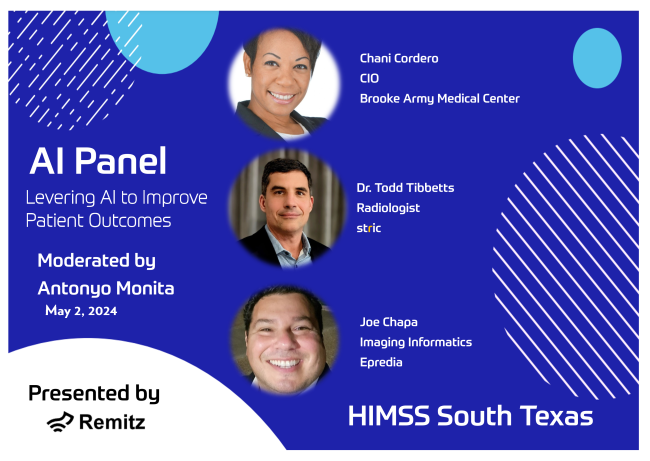
For our HLSA friends in the South Texas Chapter of HIMSS, there will be an AI Summit on Leveraging AI in Healthcare at the Chapman Center of the Trinity University Campus on May 2, 2024. Discover how AI is being used to enhance patient outcomes, streamline processes, and improve overall healthcare delivery. Network with professionals and gain insights into the future of healthcare technology. Don’t miss this opportunity to learn about the latest advancements in AI and its impact on patient care! See the agenda and times below. Seating is limited and going fast so register now!

AI Summit: Leveraging AI for Healthcare

Date: May 2, 2024

Location: Trinity University; Chapman Hall & Great Hall

Agenda:

3:00pm- 3:30pm- Check-In

3:30pm-4:30pm – AI Panel Discussion

4:30pm-5:00pm – Q&A

5:00pm-7:00pm – Networking Social

Join us at the AI Summit where experts in the field will discuss how Artificial Intelligence (AI) is revolutionizing healthcare.